Showing posts with label Business. Show all posts

Q&A: Will new deal solve Europe's problems?


European leaders have thrashed out a new deal aimed at ending months of uncertainty over the future of the euro and resolving an escalating debt crisis that has pushed several economies to the brink of collapse.

So what exactly has been agreed?

The "fiscal compact" outlines the closer integration of the national budgets of the 17 eurozone countries. A new legal framework and greater fiscal scrutiny will be imposed to avoid a repetition of the dubious financial practices that triggered the crisis. The treaty also agrees to strengthen mechanisms that guarantee short-term stability to euro economies in hot water.

The main points are:
• The legal framework will see those signed up to the deal effectively hand more sovereign powers over to centralized European control.
• Under the new deal, eurozone nations must be deliver "balanced" budgets, designed to ensure there is no repeat of the overspending and under taxation that left Greece in need of a bailout. All plans to issue national debt must be reported in advance.
• The current European Financial Stability Facility (EFSF), the money-lending safety net created by the eurozone last year to combat the crisis, will be phased out in mid-2013.
• The implementation of the eurozone's permanent bailout fund, the European Stability Mechanism (ESM), has been brought forward to 2012, and will run alongside the existing fund for about a year.
• Euro area and other EU states are working to plans to loan up to €200 billion to bolster International Monetary Fund (IMF) contingency funds. A decision will made within 10 days.
• Voting rules in the European Stability Mechanism will be changed to allow emergency decisions to be passed with an 85% qualified majority -- an attempt to move away from the deadlock that has stymied earlier bailouts.

Where will the money come from?

The bailout money comes from selling bonds guaranteed by eurozone countries. The bonds are bought by investors --- which can include countries like Japan --- in return for interest. The cash raised is then lent to the eurozone countries in trouble.

The EFSF was set up in a hurry after Greece's May 2010 bailout, and was only ever meant to be temporary. Its lending firepower has been boosted to €440 billion from an original €250 billion.

The ESM will get €700 billion in funds paid in by eurozone countries relative to the size of their economies. That cash will likely come from national treasuries. That chunk of cash sitting as back-up means the ESM will be able to lend up to €500 billion when it is fully operational.

The €200 billion earmarked for the IMF will come from Europe's national central banks. It will likely come from the banks' reserve funds, although the details are not yet fully thrashed out.

What sanctions can be imposed on countries that breach the deal?

The deal says there will be "automatic consequences" including possible sanctions if member states exceed a 3% deficit ceiling --- in other words, greatly spend beyond their means.

Legislation due to enter into force next week will introduce graduated financial sanctions for those countries which consistently breach the ceiling.

What are the consequences for the financial markets?

Global stocks were mixed after the deal was unveiled and analysts warn only time will tell if it can work. The plan could supply short term stability but previous experience on euro crisis measures shows relief can be brief.

Elisabeth Afseth, of Evolution Securities, says its success may depend on whether markets believe Europe's politicians will stick to tighter financial supervision.
Has everyone agreed to the deal?

No. Talks have been fraught and the resulting deal threatens to become one of the most divisive issues the 27-nation European Union has ever faced.

Some European Union nations have balked at ceding further powers to EU authorities and have threatened to walk away. Some say this will result in a two-tier European Union.
So who is in and who is out?

All 17 eurozone nations and six other EU states outside the euro area have signed up. Initially, four countries cast doubt on the deal, complaining that it sweeps away some of the away hard-fought foundations of the European Union.

Sweden's Prime Minister Fredrik Reinfeldt told CNN that he had no mandate for treaty change. But, alongside Hungary and the Czech Republic, he said his country would leave the door open, pending parliamentary debate.

This leaves Britain, under Prime Minister David Cameron, alone among the 27 European Union nations to point-blank refuse to sign. Cameron said the treaty failed to safeguard Britain's voice in crucial policy decisions over the European single market and financial services sector. He said he had effectively vetoed an original deal, forcing German Chancellor Angela Merkel and French President Nicolas Sarkozy to forge ahead with a treaty that will be subservient to EU regulations.

this the beginning of the end for the European Union as we know it?

The treaty has exposed deep divisions between European Union members -- chiefly Britain and the rest of the bloc.

This sets the stage for a series of legal challenges as Britain strives to ensure the treaty does not result in a wholesale restructuring of the EU.

With Britain forcing the treaty to operate outside EU mechanisms, there could be an appetite among the rest of Europe to cold shoulder the UK and concentrate resources within their new club.

That said, Britain's prior refusal to join the euro and pervading "euro scepticism" could just mean the new treaty reinforces the status quo, albeit with frostier relations.
So will this solve the crisis?

It's not over yet. The new treaty isn't due to be finalized until March 2012 after which it will have to be ratified by all participating countries. Even aside from the potential spanners in the works presented by Britain, Hungary, Sweden and the Czech Republic, grim prospects for the euro and European Union still lurk on the horizon.

Ideally, everyone will stick to the new rules, and those countries that require emergency bailouts will be granted them, allowing the European Union to slowly put its debt problems behind it.

The danger is that with politically-unpopular austerity measures biting deep, the new stricter controls on government borrowing will become unworkable. This could lead to an evaporation of investor confidence, the collapse of debt-exposed banks, an emptying of government coffers, a nosedive by share markets, and bleak prospects for the euro.

Source: CNNBUSINESS

China cracks down on rogue exchanges


The Chinese government has launched a crackdown on hundreds of unregulated electronic equity and futures exchanges that have sprung up in recent years to trade everything from fine art and commodities to insurance products.

The country's State Council, or cabinet, published a notice on Thursday announcing a campaign to "clean up and consolidate" the many exchanges that have been approved by local governments hoping to foster financial markets in their jurisdictions.

It said a task force had been set up under the securities regulator to deal with the problem and all exchanges engaged in "unauthorised and illegal" activities would be shut down.

Apart from the country's two main stock exchanges, three commodities exchanges and one financial futures exchange, no other entity is allowed to list new shares, offer centralised pricing or make markets and no more than 200 investors may hold stakes in a single traded asset, the notice said.

Investors are also banned from reselling an asset from these exchanges within five days.

Even the use of the name "exchange" in Chinese will be strictly regulated from now on and must be approved by provincial-level authorities following consultations with the securities regulator.

"Serious speculation and price manipulation has occurred" at some exchanges and cases of embezzlement and fraud have also emerged, the government said.

Although there is no official estimate for the number of unregulated exchanges or the volume of trading conducted through them, Chinese analysts say there are well over 300 of them today, up from just a handful five years ago.

Last week, three new exchanges were established in the city of Wuhan alone -- the Wuhan Shipping Exchange, Wuhan Agricultural and Livestock Products Exchange and Wuhan Financial Assets Exchange.

In the first 10 months of this year, 58 new exchanges were established, according to state media reports.

Many analysts and industry participants expect most of the exchanges will eventually be shut down and the campaign has already claimed its first casualty.

Beijing-based Hantang Artworks Exchange, where investors could trade shares in precious artworks owned by the exchange, announced on its website this week that it was halting all trading immediately "in the spirit" of the orders from the State Council.

More than 30 similar art exchanges have sprung up in the last few years but most do not appear to have been very successful and some have been mired in scandal and accusations of fraud from the outset.

"I don't think [the government] will kill all the exchanges in one go and for now I don't think the impact on our exchange will be that big," said Mr Wang, a sales manager at Inner Mongolia-based Chifeng Bulk Commodity Exchange, who declined to give his full name. "But it's true that at times we've been playing around the edges and, as an exchange, we hope the state can set up a supervision mechanism to guide the market."

In the early 1990s, Beijing launched a crackdown on hundreds of equity and commodity futures exchanges that mushroomed across the country and eventually consolidated them into the handful of large, regulated exchanges that exist today.

Source: CNNBUSINESS


Steve Jobs fielded some customer service requests


Among chief executives, Steve Jobs was an outlier. CEOs of public companies are generally hands-on, but Jobs was involved in practically every detail, from determining which industries Apple should invade to the material used for the iPhone's screen.

Jobs even got directly involved in customer service, which was a part of Apple's business for which he exercised a great deal of attention and patience. He fielded e-mails about broken laptops and intervened on support calls.

By comparison, a representative for AT&T, Apple's longtime carrier partner for the coveted iPhone, threatened a customer, who had twice e-mailed company CEO Randall Stephenson complaining about price hikes, with a cease-and-desist notice.

"I don't think even Steve Jobs can spin 2 GB for $25/month as a good thing for the consumer," the customer, Giorgio Galante, wrote in his recap, as reported by Wired, which is a CNN.com content partner.

Unlike other leaders, Jobs was not only handling an unusual number of his company's own basic customer service inquiries, but he also fielded some of Stephenson's, since AT&T and Apple were conjoined on various business interests relating to the iPhone and iPad.

When a customer asked Jobs via e-mail in 2008 why BlackBerry owners could tether their phones to their computers for wireless Internet access but the same could not be done with an iPhone, Jobs wrote, "We agree, and are discussing it with ATT." The feature eventually came.

Asked about tethering an iPhone to an iPad on AT&T, Jobs replied only, "No."

Jobs consoled another AT&T customer, Mark Trapp, who expressed his frustration over his cell carrier's plans to discontinue unlimited data plans. "I think its (sic) going to work out just fine for almost all customers. Try it," Jobs wrote, but he was less supportive in a message to another customer, Dennis Wurster, about the same matter: "It's between you and ATT."

Steve's proclivity for responding to e-mails, and the reputation that came with that, made his inbox a prominent target for customers looking to overstep rows of supervisors to get broken computers replaced and generous credit for service outages. This approach intensified as his legendary reputation and Apple's customer base grew.

Apple took notice and repurposed the messages to be used as data points for internal use, evidenced by a graph charting customer complaints about the ill-fated Internet service, MobileMe.

Long before that, however, Jobs was extraordinarily embedded in handling customer complaints. On October 11, 1999, not long after Jobs returned to a dying company and took on the title of interim CEO (or iCEO), he fielded an inquiry from a customer named Davidabout iBook laptop shortages.

"We are doing the best we can with a limited supply (which is finally now increasing). Please remember that some of the first pre-orders came from CompUSA," Jobs wrote.

Dozens of stories have floated around the Web about the times when an e-mail to Jobs yielded a phone call from an executive support team and an outcome that far exceeded reasonable expectations. In 1999, a customer got his G4 Tower desktop repaired after an e-mail to Jobs resulted in a phone call from the mysterious Executive Relations team.

In 2001, a student software developer was told by Apple support that, despite his sob story about dropping the hard drive connected to his laptop causing damage, they couldn't resolve an issue that resulted from physical abuse. After writing to the CEO, he got a call from one of Jobs' associates who asked him several questions and then tempered his expectations by saying similarly that he did not meet the standards for a comped repair.

Source: CNNTECH

Clock ticks down on super committee

The congressional deficit reduction super committee is trying to find at least $1.2 trillion in savings over the next decade.


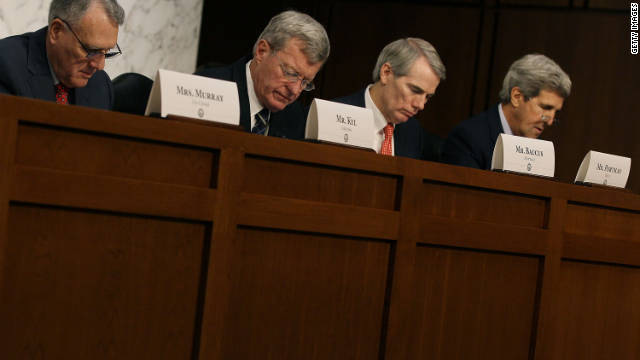
 Members of Congress's so-called super committee huddled in small groups behind closed doors on Capitol Hill on Friday, battling growing pessimism over their seeming inability to meet a now-imminent deadline for a bipartisan deficit reduction deal.
At least seven of the panel's 12 members, evenly split between Democrats and Republicans in the House and Senate, need to agree by Wednesday on savings of at least $1.2 trillion over the next decade. In reality, however, the timeline is even shorter. Under the law creating the committee, any proposal must be made public and evaluated for its fiscal impact by the nonpartisan Congressional Budget Office no later than Monday.
"Time is running out," panel members Rep. Chris Van Hollen, D-Maryland, and Sen. Pat Toomey, R-Pennsylvania, each said Friday morning.
"We're here. We're working. We're talking," Toomey added. "It's difficult, but it's still possible."
Both sides say they will work through the weekend to try to reach an agreement.
If the committee defies expectations and beats the clock, Congress will have one month -- until December 23 -- to vote on the deal, which cannot be amended.
A failure to pass any agreement would result in $1.2 trillion in automatic across-the-board spending cuts starting in 2013, evenly divided between defense and non-defense spending. Defense Secretary Leon Panetta warned Congress this week that such cuts could cripple the American military establishment.
While Democrats have expressed concern about deep cuts in social spending, programs such as Social Security, Medicaid, food stamps and veterans' benefits would be spared the budget ax.
Republicans -- including House Speaker John Boehner -- floated the possibility Friday of a backup plan of $640 billion in savings described as "low-hanging fruit," according to multiple sources. The plan would include roughly $540 billion in spending cuts and fees, the sources noted.
Such a measure would allow negotiators to at least claim partial success and reduce the scale of the largely unpopular automatic cuts.
Democrats balked, however, for the same reason they've also rejected larger GOP proposals: a perception that there's not enough "shared sacrifice" in the form of higher taxes on the wealthy, the sources said.
"No person could look at that (alternative plan) and say it met the test of fairness and balance," Van Hollen said.
The latest apparent failure followed a day-long blame game Thursday, with each side blasting the other for being unreasonable. Republicans continue to say Democrats aren't bending enough in terms of spending cuts; Democrats claim Republicans need to go further on tax hikes.
Democrats are "well aware of what we're willing to do," said Boehner, R-Ohio. "You can lead a horse to water, but you can't make him drink."
House Minority Leader Nancy Pelosi, D-California, claimed Democrats would prefer a "big, bold and balanced" package addressing entitlement programs and other major drivers of deficit spending, but said the "revenue piece seems to be the stumbling block for the Republicans."
Pelosi's comments appeared to be reinforced when 72 conservative House Republicans publicized their opposition to any agreement that would include tax increases. Such a large voting bloc within the GOP House majority means Boehner will need support from Democrats for any deal incorporating new revenues.
Key Republicans broke with their party's anti-tax orthodoxy this week with news of a proposal by Toomey that includes $400 billion in increased revenue, including tax hikes.
Toomey's plan would lower overall tax rates while limiting tax breaks in a way that would raise $250 billion. Republicans estimate that the reform would lead to economic growth generating another $110 billion. A change in how tax brackets are adjusted for inflation would raise another $40 billion.
The plan also includes $800 billion in spending cuts, thereby hitting the minimum threshold of $1.2 trillion in deficit reduction.
In response, Democrats initially said the additional tax revenue wasn't enough. They later partially backtracked, saying they could agree to the GOP's overall revenue number but not how the revenue would be generated.
Among other things, Democrats called for all $400 billion of the new revenue to come from increased tax collections. They also opposed a GOP demand to make permanent the Bush-era tax cuts, now set to expire at the end of 2012.
In addition, the Democratic package would include spending of about $700 billion on measures progressives believe are needed to jump-start the economy: an extension of the payroll tax cut and continued benefits for people who have been unemployed for an extended period.
It also would include money to permanently prevent cuts in payments to doctors who treat Medicare patients. Democrats want to offset those costs with money saved from winding down the wars in Iraq and Afghanistan, a move some legislators in both parties characterize as an accounting gimmick.
In return for accepting the GOP figures, Democrats also said they would not accept Republican demands to raise the Medicare eligibility age to 67 or lower cost-of-living increases for Social Security beneficiaries.
A spokesman for Boehner called the Democratic counteroffer a "backward step."
One question hanging over the talks is how financial markets would react if a deal is not reached. Conversations with stock and bond strategists indicate Wall Street has already factored in low expectations for the super committee, partially due to the near-disastrous brinksmanship that accompanied this past summer's debt ceiling debate.
If the panel can agree on $1.2 trillion in savings, the market reaction will probably be "a great big yawn," said Adrian Cronje, chief investment officer of Balentine, an investment advisory firm.
If the panel fails to reach a deal, "global and U.S. investors will continue to be disappointed in U.S. fiscal policy but will (also) look at Europe and Japan and not see governments with unassailable credit ratings in the future," said Steve Van Order, fixed income strategist at Calvert Investments
Source: CNNBUSINESS

Millionaires ask Congress to raise their taxes


 A group of two dozen millionaires stormed Capitol Hill on Wednesday, demanding lawmakers raise their taxes.
"We want to pay more taxes," said California millionaire Doug Edwards, a former marketing director for Google (GOOG, Fortune 500). "If you're fortunate, and you make more than a million dollars a year, you ought to pay more taxes."
The millionaires want Congress to allow the tax cuts passed during the George W. Bush administration to expire. Some want higher taxes generally.
They planned to push lawmakers to reject any deal that the so-called super committee delivers that doesn't raise taxes on millionaires. The 12-lawmaker panel has until next Wednesday to agree on $1.2 trillion in savings over the next 10 years or risk automatic spending cuts.
"If the super committee bill doesn't raise our taxes, we will ask our fellow citizens to consider killing the bill," said Eric Schoenberg of Franklin Lakes, N.J., an adjunct professor of marketing at Columbia Business School.
They planned to take their message to members of the super committee, Tea Party Republicans including Rep. Louie Gohmert of Texas and Rep. Tom Price of Georgia, and even anti-tax champion Grover Norquist.
The group was formed a year ago to push for expiration of the Bush tax cuts, and includes several current and former Google employees. Some of the better-known millionaires in the group include economist Nouriel Roubini, and a few celebrities, such as "The Sopranos" star Edie Falco and filmmaker Abigail Disney, who didn't make the trip to Washington.
Five different members declined to say what their annual income is, only acknowledging that they could be called millionaires.
Massachusetts millionaire Farhad Ebrahimi, a 33-year-old philanthropist who inherited his money from his software entrepreneur father, said he also supports the so-called "Buffett rule" that would require millionaires to pay a higher percentage of their income in federal taxes than those who make less than a million a year. The rule is named for the measure's chief supporter, Berkshire Hathaway (BRKA, Fortune 500) chairman Warren Buffett.
But he said the first thing on the group's bucket list is convincing Congress to allow Bush tax cuts to expire for the wealthy.
"What we're all here today representing is to request the Bush tax cuts be allowed to expire -- that's simply the bare minimum," said Ebrahimi, who has also participated in protests in the Occupy Boston movement.
Source: CNNMONEY

Google opens online music store and free storage locker

Google opened an online music store and a free Web storage locker on Wednesday for listening to tracks from computers, tablets and phones, the company announced at a news conference in Los Angeles. The music store sells songs and albums for prices comparable to iTunes and Amazon MP3, but Google's catalog is smaller. The storefront can be found in the Android Market, an application and website where Google smartphone users can download apps.
Songs purchased from the store are automatically uploaded to Google Music, a locker that can be accessed from an app coming to recent Android phones and tablets in the next few days, or from a website. They allow users to stream songs from their various devices.
The Google locker service launched to a small group in May, and it opened to everyone in the United States on Wednesday. Google Music is free for storing as many as 20,000 songs.
More than half of all smartphones sold worldwide in the last quarter run Google's Android software, according to market research firm Gartner. Google said more than 200 million devices have been activated.
But in the music download market, Apple is king, selling more than half of all U.S. downloads through its iTunes Store, analysts say.
Apple took steps to broaden its offering with the belated launch of iTunes Match on Monday. ITunes Match is similar to Google Music in that it allows customers to store their music catalogs, up to 25,000 songs, on Apple's servers and access them from their computers, iPhones and iPads. Match costs $25 per year.

"At Google, digital music has become fundamental to many things we care very much about," Jamie Rosenberg, Google's director of content for Android, said onstage at the news conference. "Other cloud music services think you have to pay to listen to the music you own. We don't."
ITunes Match has a technological leg up on Google because subscribers can upload their libraries much more quickly. That's thanks to Apple's deals with the music labels that allow it to provide customers with access to the high-quality versions of songs that iTunes sells. With Google Music or Amazon.com's Cloud Drive, users with a lot of music may have to wait several days for their entire catalogs to upload.
The iTunes Store has about 20 million songs, whereas Google has 8 million. Google has signed deals with three of the big four record labels. Warner Music Group, the third largest, whose musicians include Death Cab for Cutie, the Grateful Dead, Muse and T-Pain, is a holdout. Even without Warner, Google said it will add 5 million songs over the next several months.
Customers of T-Mobile USA's cellular network will be able to charge songs to their phone bills rather than setting up a Google account with a credit card.
After buying a song through Google Music, customers can share the track on the Google+ social network. Not surprisingly, Google Music will not integrate with Facebook Music, the aggregation service that launched recently from Google's social-network rival.
Google touted that, unlike other music stores, people who find songs through Google+ will be able to listen to each one in full for free one time before they buy. ITunes only provides 90-second previews. Google has also secured exclusive access to live records from popular bands including Coldplay and the Rolling Stones. Apple is still the only music-download store that has the Beatles.

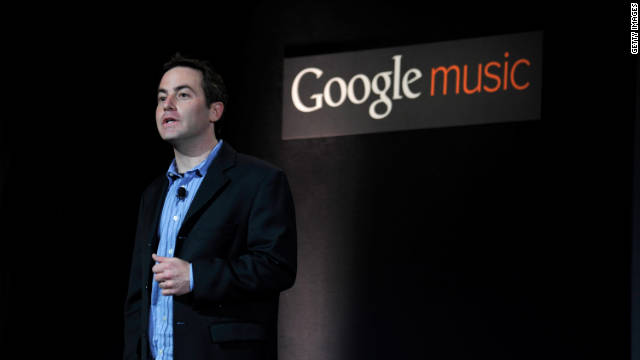
Google's Jamie Rosenberg announces the Google Music store and locker in Los Angeles.

Apple's cloud-based music service now live on iTunes

Songs are saved to the cloud automatically, so there's no need to download them onto each of your devices.


 iTunes 10.5.1 is now available, and with it comes iTunes Match, Apple's cloud-based music subscription service.
For $25 a year, Match drops any track you purchase from iTunes directly into Apple's iCloud. Songs are saved to the cloud automatically, so there's no need to download the song from iTunes separately on each of your iDevices.
iTunes Match also takes care of songs that weren't purchased from iTunes. The service scans all the songs in your library, and if it finds a match in the iTunes store, you don't need to upload that song yourself -- instead it uses the 256Kbps AAC DRM-free copy that Apple already has in iTunes. And if it doesn't find a version of the song in your library, it'll upload your version.
iTunes Match is limited to 25,000 songs, and can work with up to 10 different devices.
iTunes Match has been available exclusively for developers since late August, and was supposed to land by the end of October.
To get iTunes Match, just upgrade your iTunes version to 10.5.1, click the iTunes Match link on the iTunes Store page, and sign up using your Apple ID and your favorite credit card. Depending on the size of your collection, the initial scanning and uploading process could take a few hours.
Registration availability is currently a bit spotty as users flock to download iTunes Match, so you may get a message (like in the screenshot above) that tells you new iTunes Match subscriptions are unavailable, and to check back in an hour or two.
Source: CNN

Apple names new chairman of the board

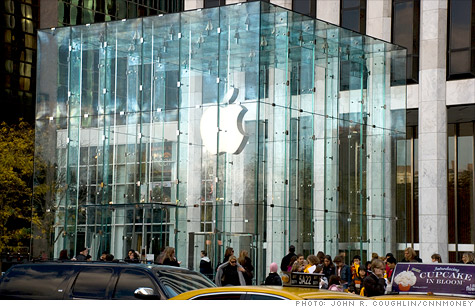
apple-store-nyc.jc.top.jpg
NEW YORK (CNNMoney) -- Apple filled its chairman of the board void left by Steve Jobs's death, naming the board's co-director Arthur Levinson to the position.
The company also appointed Bob Iger, Disney's CEO and a former close personal friend of Jobs, to the board.
art_levinson__2005.03.jpg
Art Levinson was named Apple's chairman of the board.
"Art has made enormous contributions to Apple since he joined the board in 2000," said Tim Cook, Apple's CEO, in a prepared statement. "Bob and I have gotten to know one another very well over the past few years and on behalf of the entire board, we think he is going to make an extraordinary addition."
Levinson, a board member since 2005, is the company's longest-serving director. He is also chairman of drugmaker Genentech and a board member of Roche, another pharmaceutical company. Levinson was Genentech's CEO for 14 years until he stepped down in 2009.
He had also sat on Google's (GOOGFortune 500) board until 2009, when it became clear that Apple and Google were becoming competitors, particularly in the mobile space. He departed Google's board two months after then-CEO of Google Eric Schmidt stepped down from Apple's (AAPLFortune 500) board.
"Apple is always focused on out-innovating itself through the delivery of truly innovative products that simplify and improve our lives, and that is something I am very proud to be a part of," Levinson said Tuesday in a statement.
Iger, who is set to become chairman of the Walt Disney Co. (DIS,Fortune 500) in March and step down as its CEO in 2015, befriended Jobs when he headed up Pixar. Jobs sold Pixar to Disney in 2006, making Jobs then Disney's largest individual shareholder as well as a member of its board of directors.
When Jobs' death was announced last month, Iger called Jobs "a great friend as well as a trusted advisor."
"I am extremely pleased to join the board of such a wonderful company," said Iger in a statement. "Over the years, I have come to know and admire the management team ... and I am confident they have the leadership and vision to ensure Apple's continued momentum and success."
Cook said he believes Iger is a great fit for Apple's leadership team, since Disney's success is based on creativity, innovation and expansion into new markets -- three fundamentals that have helped Apple become the most valuable company on the stock market.
Source: CNN

Related Posts Plugin for WordPress, Blogger...